Recover
Recovering from Burnout
What does recovery actually look like — and how do I know if I’m getting better?
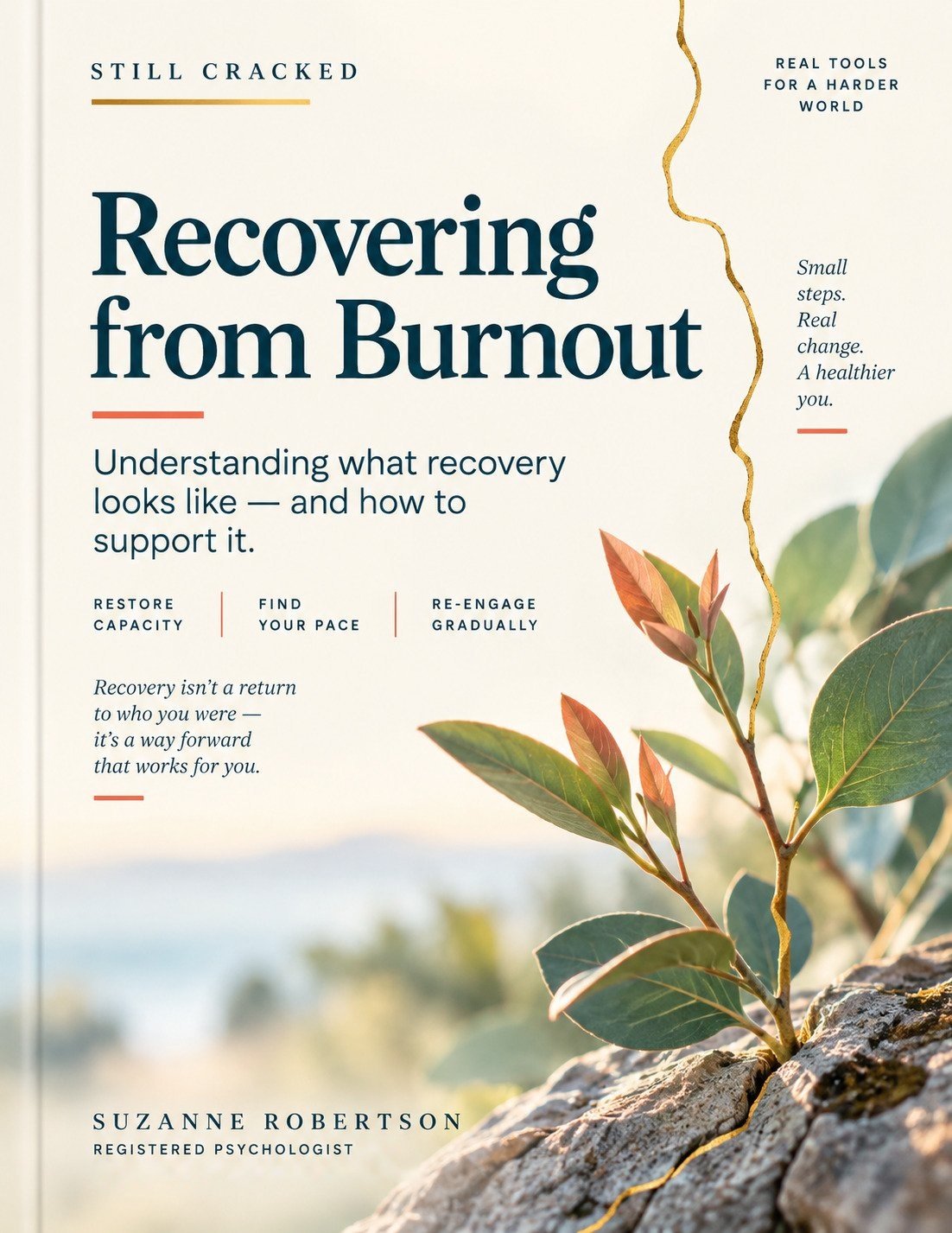
Burnout recovery is possible. But it is rarely as simple as resting until you feel better.
A 50-page guide to what recovery can involve, what helps at different points, and how to rebuild without repeatedly outrunning your capacity. It is designed to be read while depleted.
 Written by Suzanne Robertson, registered psychologist
A$22 · 50-page PDF guide · Instant download
Get Recovering from Burnout — $22Is this for you?
- You have rested, but you still don’t feel like yourself.
- You are starting to feel better and aren’t sure when it makes sense to do more.
- A good day can still be followed by a crash that wipes out the next day or two.
- You are preparing to return to work — or already back — and don’t want to slide straight into the same pattern.
How do you recover from burnout?
Recovery usually involves more than rest. It may include reducing or changing the demands that contributed to burnout, allowing enough genuine recovery, rebuilding capacity gradually, and changing the conditions you are returning to where that is possible.
The balance is different for different people. The important point is that recovery is not only about becoming less tired — it is about being able to meet ordinary demands without repeatedly crashing afterwards.
Why a weekend or holiday often doesn’t fix it: understanding burnout.
What this helps you do
Understand what recovery actually involves
See why feeling less exhausted is only one part of recovery, and what else may need time to come back.
Pace the rebuild
Work out how to increase activity and demands without treating every good day as proof that you are ready for everything again.
Notice whether capacity is really returning
Look at the floor of what you can reliably manage, rather than judging recovery by your best day.
Think through returning to work
Consider workload, duties, support and the conditions you are returning to — not only whether you can get through the first week.
What you get
50-page PDF guide
Designed to be read in pieces rather than finished in one sitting.
Five-part recovery map
Stabilise, reduce and protect, rebuild, re-engage and sustain — used as different jobs, not rigid stages.
Pacing + capacity tools
Including the good-day trap, boom-and-bust patterns and a thirty-second daily check.
Two composite examples
Jenny and Anthony show how recovery can look across a life rather than as a list of instructions.
Return-to-work material
Hours, workload, duties, support and what may need to be different as work increases again.
Two worksheets + references
Pages to work through and return to, with references and further reading included.
Inside the guide
Why rest helps — and why it may not be enough
What genuine recovery time involves and why improvement can fade when the conditions around you stay unchanged.
A practical map of recovery
Five different jobs rather than a fixed sequence: stabilise, reduce and protect, rebuild, re-engage and sustain.
Pacing + the good-day trap
Boom and bust, capacity and how to increase without automatically treating one better day as the new baseline.
Telling whether you are actually getting better
What a rising floor can look like, what to check and what not to measure yourself against.
The psychological side
Confidence, guilt, fear, grief, anger, cynicism and how burnout can affect professional identity.
The workplace + going back
What the conditions around you have to do with recovery, return to work and what may need professional support.
Take a look inside
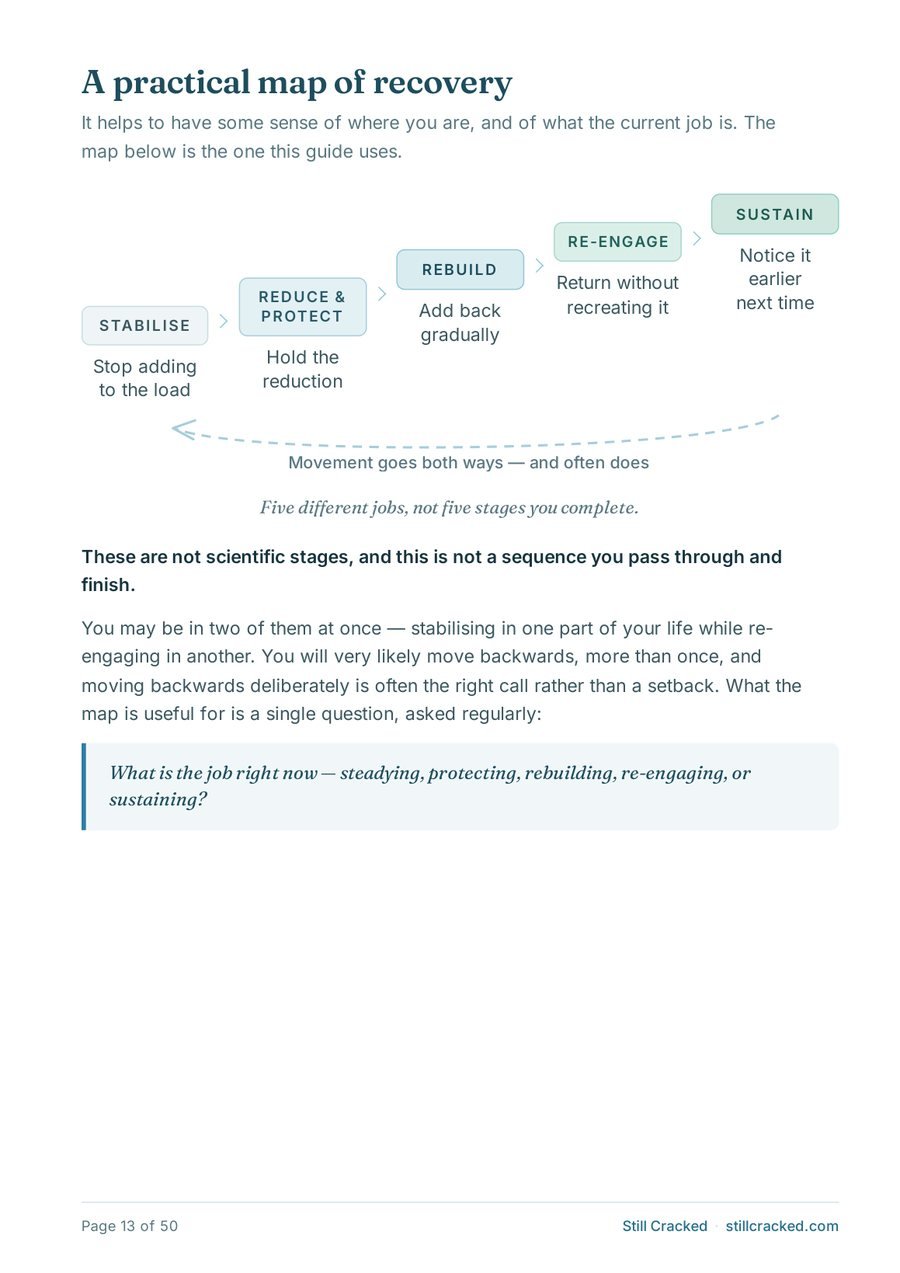
See the recovery map
Stabilise, reduce and protect, rebuild, re-engage and sustain — and why movement does not only go in one direction.
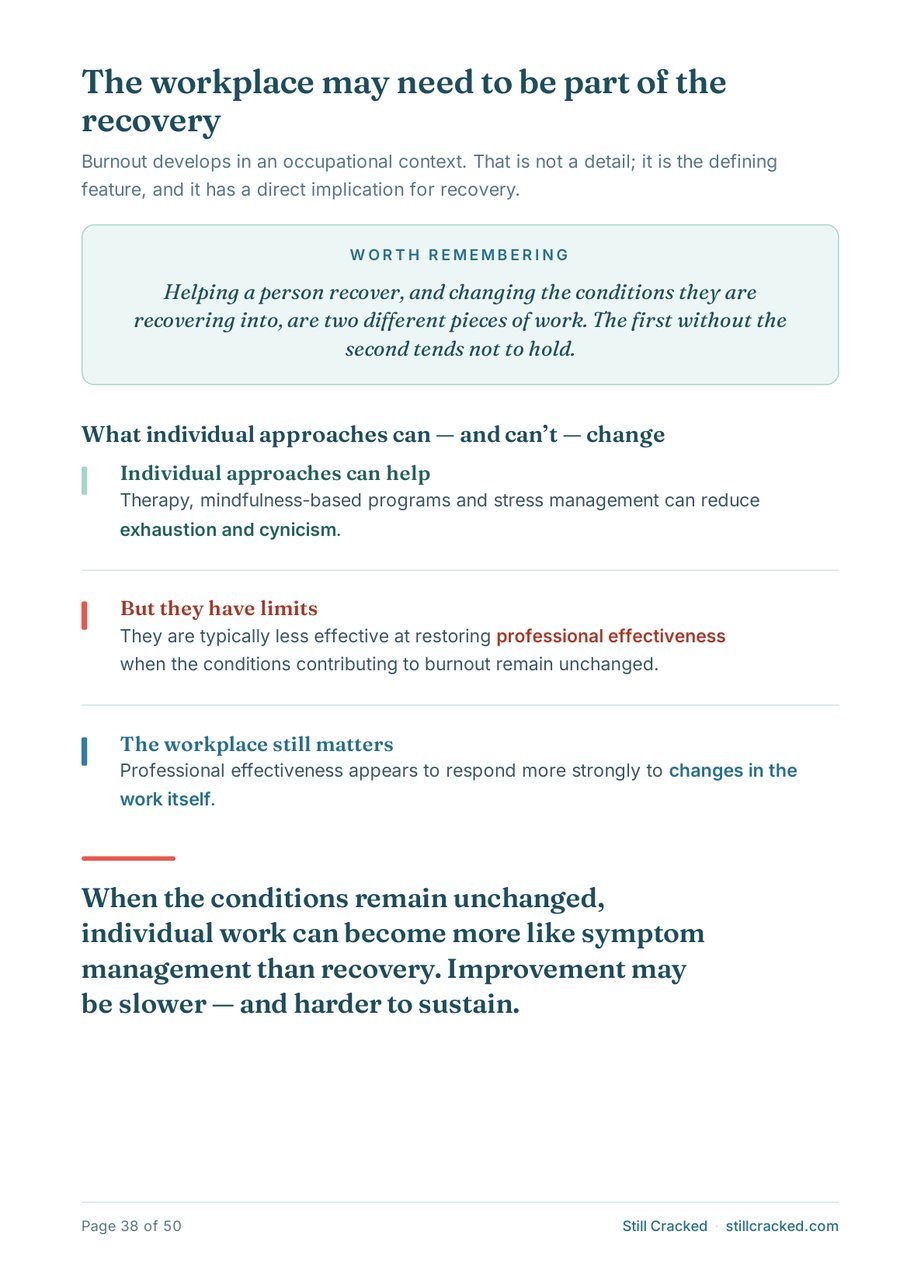
Keep the workplace in the picture
What individual approaches can help with — and what they cannot change when the conditions around the person remain the same.
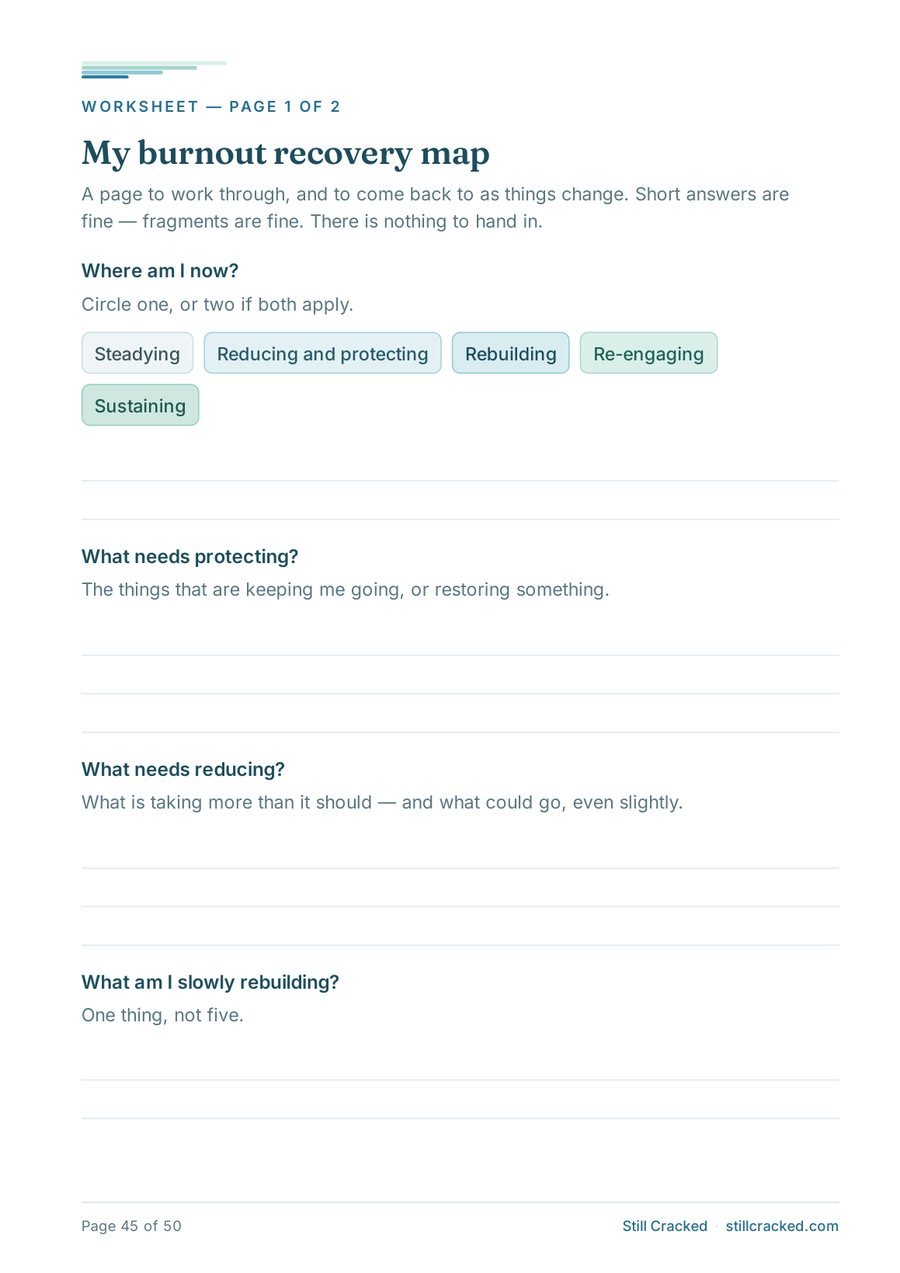
Turn it into something usable
One of the worksheet pages for mapping where you are now and what needs attention next.
How to use it
You do not need to read this in one sitting.
Start with the question that is most relevant now and come back to the rest as your capacity changes.
The clickable contents page makes it easy to move around, and the two worksheets are there when you want to turn the reading into something more concrete.
Read it on a phone or laptop, or print it if that works better for you.
Read what you need. Leave the rest for later.
Is this the right resource?
Recovering from Burnout or Burnout Reset Kit?
Recovering from Burnout — $22
Choose this if you’ve stepped back, had time off or hit a wall, and are now rebuilding.
Burnout Reset Kit — $27
Choose this if you’re burnt out but still have to keep working or functioning, and need practical tools to reduce the load while you recover.
See the Burnout Reset KitAbout the author
Suzanne Robertson
Psychologist · Founder, Still Cracked
Suzanne Robertson is a registered psychologist with more than twenty-five years’ experience. Her Master of Counselling Psychology research focused on burnout, and her work includes burnout, workplace psychological harm and recovery.
She created Still Cracked to turn psychology and research into practical, plain-English resources people can use outside the therapy room.
Questions before you buy
How do I get it?
Straight after payment, your download link appears on the order confirmation page, and the same link is emailed to you. Nothing is posted, and you don’t need to create an account.
Can I read it on my phone?
Yes. It is a PDF with a clickable contents page, so you can read it on a phone, tablet or laptop and jump straight to the part you need. It is A4, so it also prints cleanly if you prefer paper.
Is this therapy or a diagnosis?
No. Still Cracked is education, not treatment. The guide explains what recovery can involve and helps you think it through, but it does not assess or diagnose you. If you are struggling, your GP or a psychologist is a good place to start. If you are in crisis, call Lifeline on 13 11 14, or 000 in an emergency.
What if it isn’t what I need?
Because it downloads instantly, change-of-mind refunds aren’t offered, so look through the sample pages and the comparison above before you buy. If the file doesn’t arrive, won’t open or isn’t what this page describes, email hello@stillcracked.com and it will be put right. Read the refund policy.
Get Recovering from Burnout
Understand what recovery can involve — and what may need to change as capacity comes back.
A$22 · 50-page PDF guide · Instant download
Get Recovering from Burnout — $22Instant download: your link appears on the order confirmation page and is emailed to you. A4 PDF, for screen or print.
Still Cracked is education, not treatment.
Change of mind isn’t covered on instant downloads. Your rights under the Australian Consumer Law are not affected: if something doesn’t arrive, won’t open, or isn’t what was described, email hello@stillcracked.com and it will be put right.