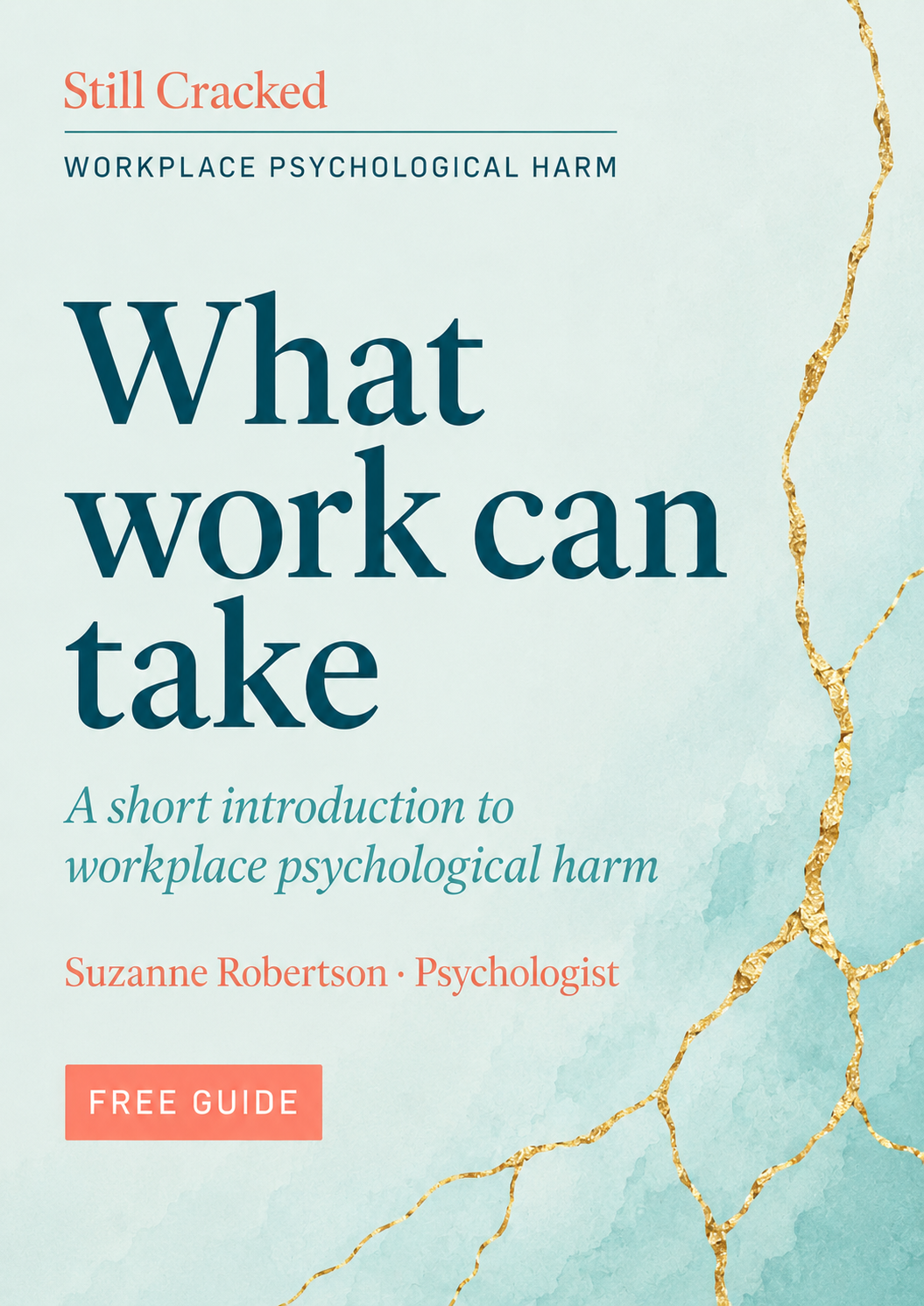
Free guide
What work
can take
A plain-English guide to workplace psychological harm — what it can look like, where it can come from, and what may help.
Sometimes it’s what’s happening at work.
Workload, staffing, emotionally demanding contact, being close to other people’s distress, bullying or aggression, unsafe conditions, and work that goes against your own judgement.
Sometimes it’s what the workplace does.
Complaints, investigations, being stood down, performance processes, compensation and return-to-work — and the delays, silences and decisions along the way.
Sometimes it’s what it gets put down to.
The times when the focus moves onto your resilience, your coping or how you communicated — and the workplace drops out of the account.
Get the guide
Enter your email and it will be sent to you.
You’ll also receive occasional Still Cracked resources and writing. No daily emails. Unsubscribe anytime.
What’s inside
What you’ll be able to work out
Not a checklist to score yourself against. Language for what has been happening, and a way to tell which part of it is which.
-
Language for some of what can happen
Plain-English explanations of concepts such as institutional betrayal, without turning a label into the whole explanation.
-
A way to separate what is happening
Questions that help you look separately at what’s happening at work, what the workplace does, and what it gets put down to — because they don’t necessarily have the same answer.
-
What the workplace does about it
Complaints, investigations, processes and returning to work — and the parts of them that can add to the strain, whether or not you raised anything.
-
What your employer is responsible for
Psychosocial hazards explained without the jargon, and what an employer is expected to do about them.
-
Examples from different kinds of work
Not only nursing, teaching and social work. Examples drawn from a range of jobs.
-
Where to start
A few questions to sit with, and practical places to go next.
Who it’s for
It isn’t only for helping professionals
Nursing, teaching and social work are in it. So are retail, trades, transport, hospitality, call centres, construction, administration and management. Work can take a psychological toll in any job.
It may be useful if:
- the workload or the expectations are more than the job can hold;
- the conditions make the work hard to do properly — staffing, resources, rosters, time;
- management or support is thin, unreliable, or there when it suits and gone when it doesn’t;
- there is bullying, aggression or ongoing conflict;
- you are being asked to do things that go against your judgement or what you believe is right;
- a complaint, an investigation or a workplace process has become another source of stress;
- you are running on empty, or more is coming at you than you can take in;
- you have lost confidence in work you used to do well;
- you have stopped feeling much about work you used to care about;
- you are being treated as though you are the problem;
- you are trying to work out whether what is happening at work is actually reasonable.
This is educational information, not individual advice. It isn’t a diagnosis, a clinical assessment or legal advice. Where something is uncertain, the guide says so.
If work is costing you more than it should, start by working out what you’re actually dealing with.
You don’t have to be sure what happened to start working it out.
Get the free guide