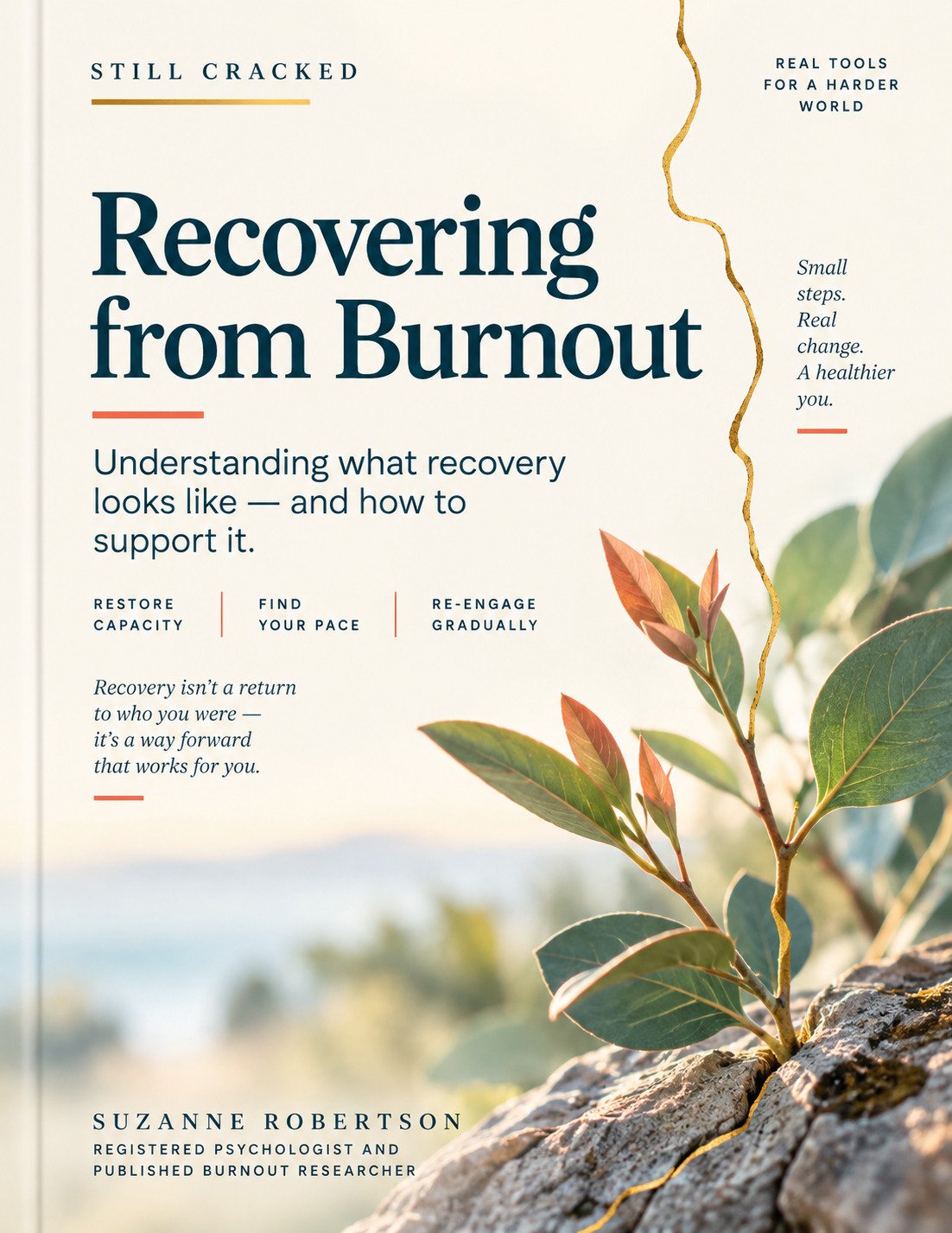
Recover
Recovering from Burnout
What does recovery actually look like — and how do I know if I’m getting better?
Burnout recovery is possible. But it is rarely as simple as resting until you feel better.
A 50-page guide to what recovery can involve, what helps at different points, and how to rebuild without repeatedly outrunning your capacity. Written by a psychologist, and designed to be read while depleted.
- 50-page PDF guide, plus cover
- Downloads immediately — nothing recurring
- Clickable contents; reads on a phone, a laptop or printed
- Written in Australia, for Australian workplaces
If one of these is the question you keep coming back to
- I have rested. Why do I still not feel like myself?
- I am starting to feel better. How do I know when I am ready to do more?
- Why do I get one good day and then lose the next three?
- How do I go back to work without ending up exactly where I started?
The guide works through each of these — including why rest matters, why it may not be enough on its own, and where the answer is not yours alone to make.
What is actually recovering
Recovery is more than becoming less exhausted
Exhaustion is often the easiest part to notice, and sometimes one of the first things to improve. That can make it tempting to return to full demands before the rest has caught up.
- Physical energy and stamina
- Concentration, memory, and the ability to plan and organise
- Emotional tolerance — ordinary frustrations landing as ordinary again
- Stress reactivity — settling faster after something difficult
- Interest and engagement in things that used to matter
- Confidence, which usually returns more slowly than capacity does
- Meeting ordinary demands without repeatedly crashing afterwards
Being able to meet ordinary demands without repeatedly crashing afterwards. The guide’s working definition of recovery
What’s inside
Six things the guide works through
-
Why rest is necessary and rarely sufficient
Why improvement can fade after returning if nothing else has changed. What genuinely switching off means, what makes non-work time restorative, and when “just switch off” is not adequate advice.
-
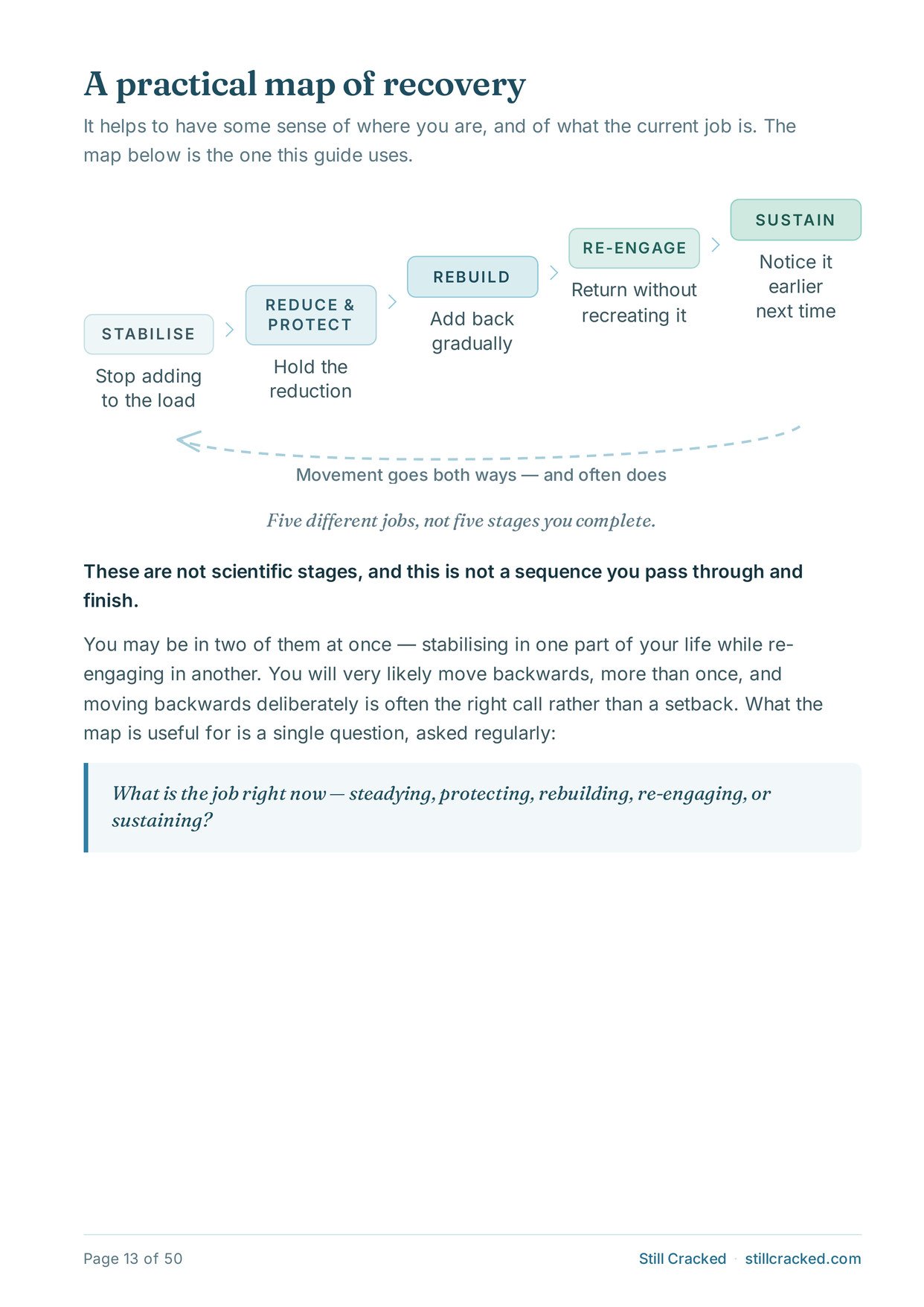
A practical map of recovery
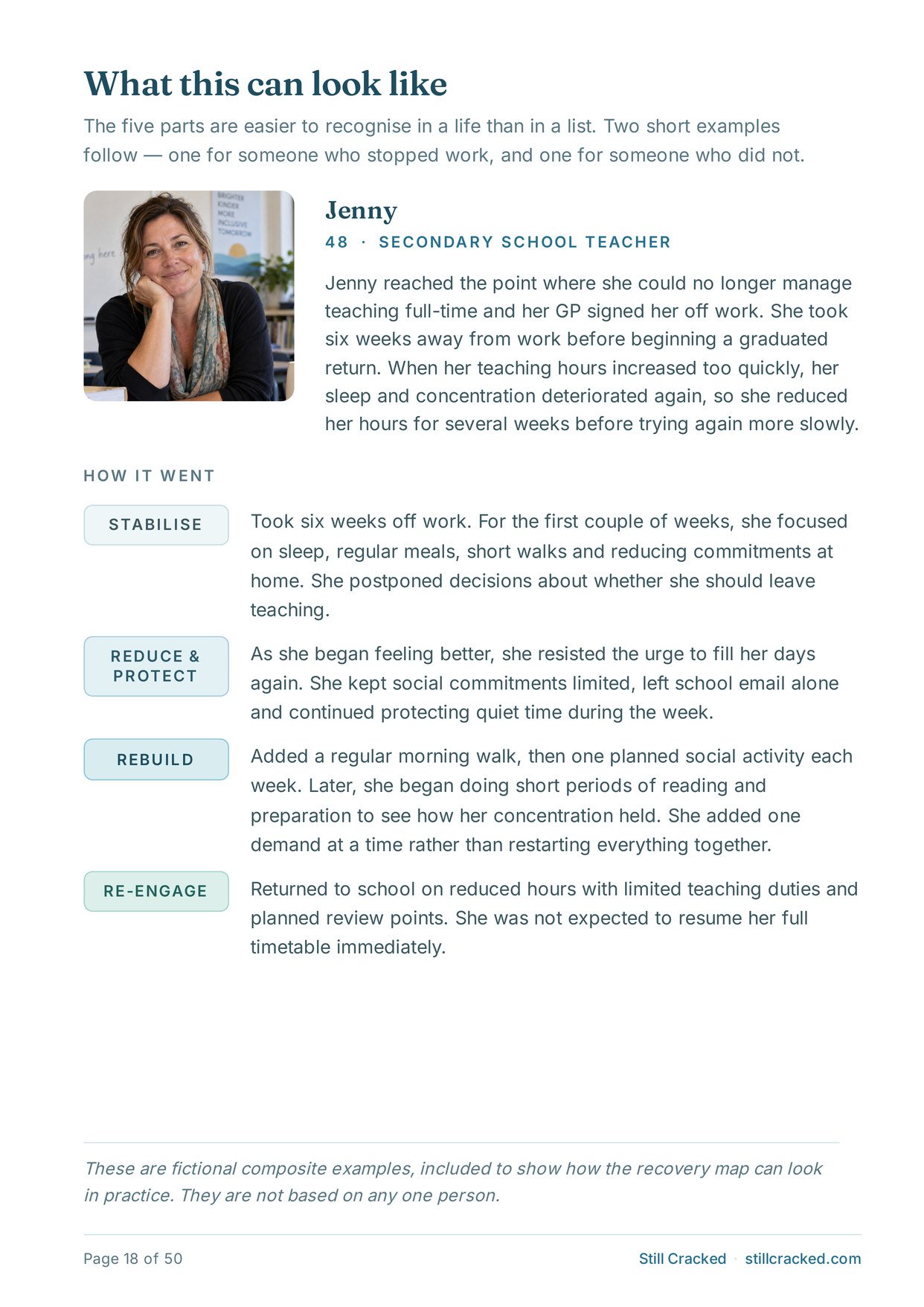
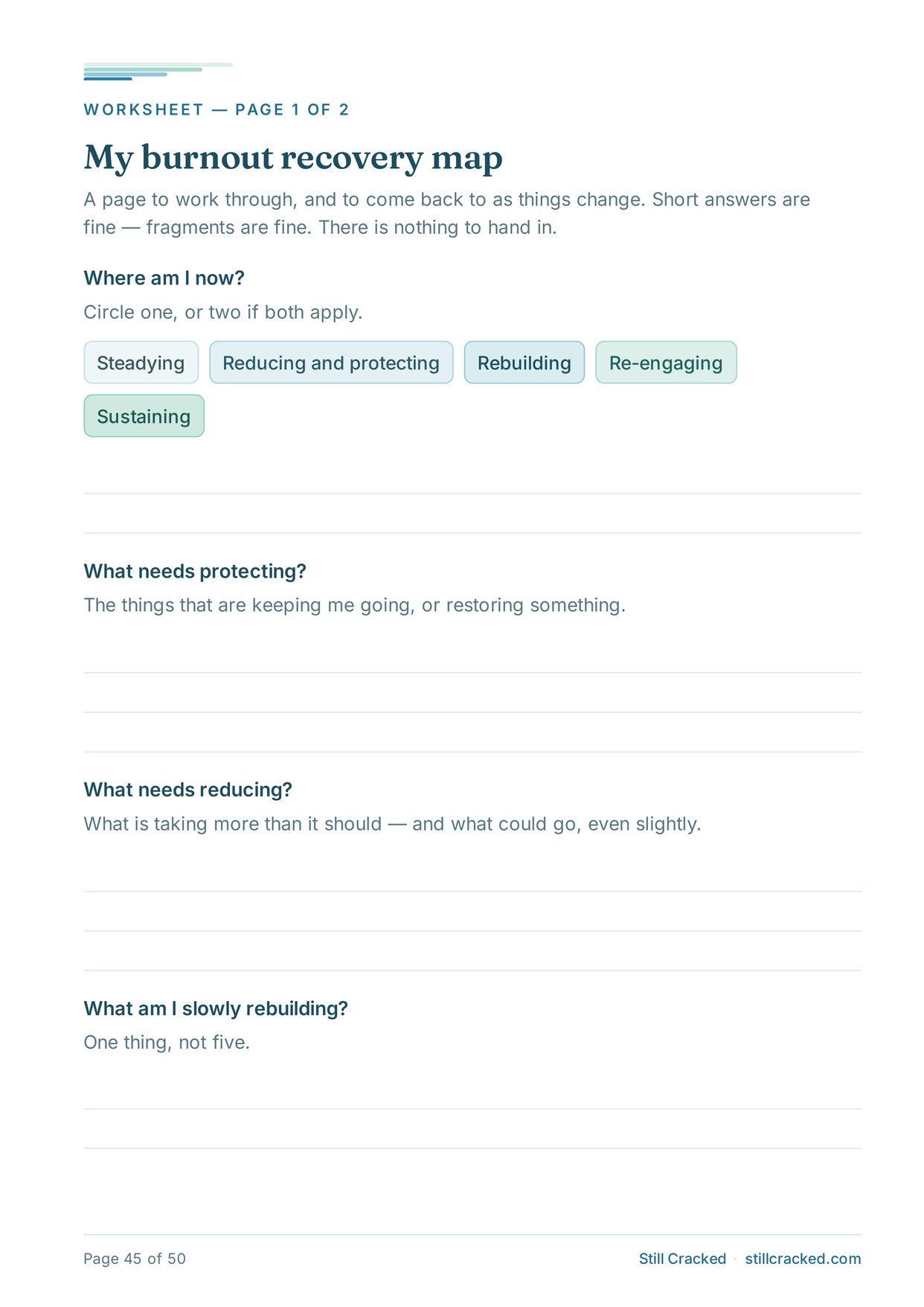
Five different jobs rather than five stages: stabilise, reduce and protect, rebuild, re-engage, sustain. Each one set out in detail — what may be happening, what you may need, what helps, and what tends to go wrong. Jenny and Anthony, two fictional composite examples, show how the map looks across a life rather than in a list.
-
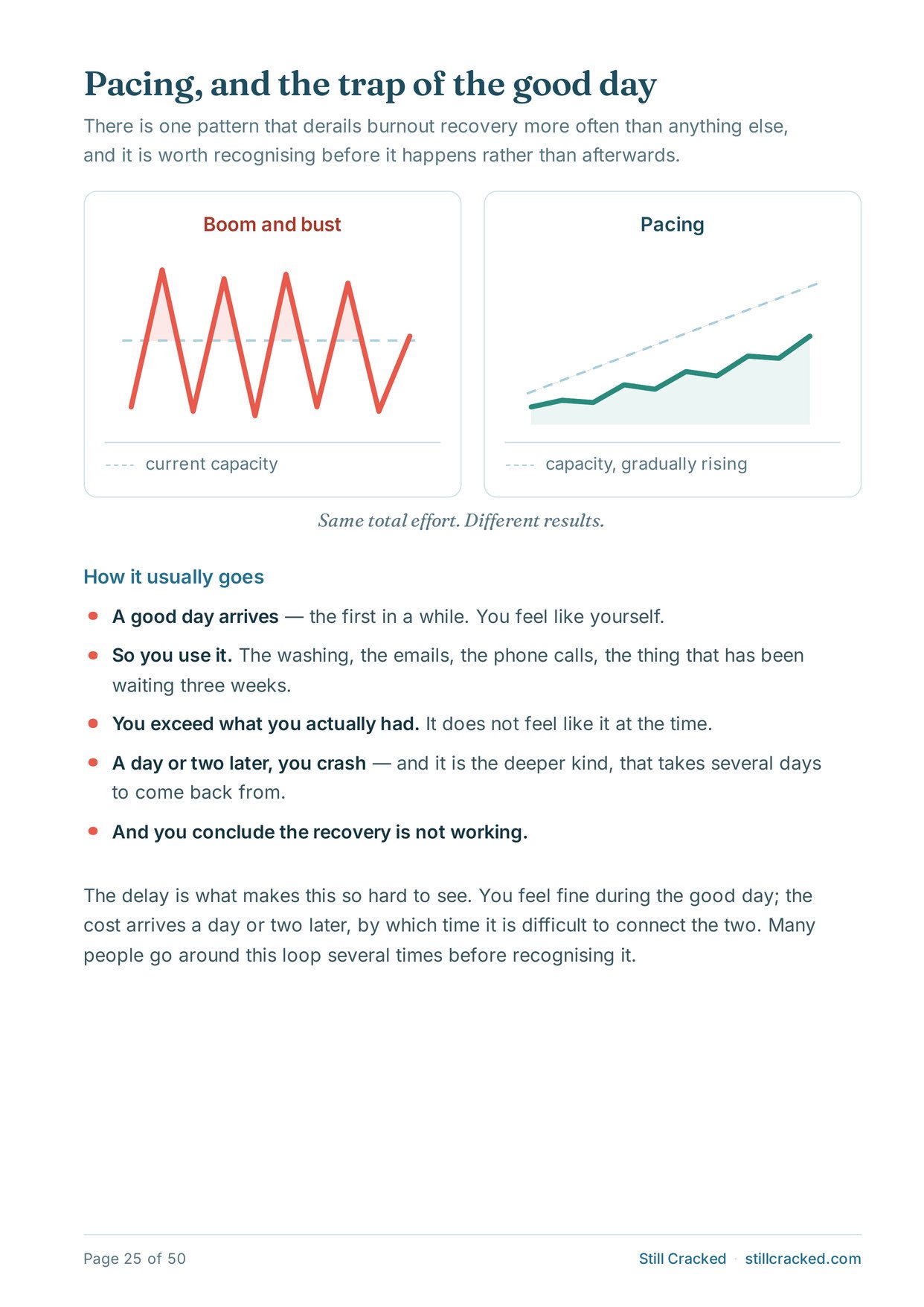
Pacing, and the trap of the good day
Boom and bust, and why the crash arrives a day or two after the good day rather than during it. Three currencies drawing on one account. A thirty-second morning check, and how to increase without crashing.
-
Telling whether you are actually getting better
Measuring the floor rather than the ceiling, what a rising floor looks like, how often to check, and what not to measure yourself against.
-
The psychological side
Guilt about resting. Feeling lazy. Loss of confidence, and why confidence can lag behind returning capacity. Fear of returning to work, hypervigilance, grief, anger, cynicism, and what burnout does to professional identity. Also what may be sitting alongside the burnout and needs treating in its own right.
-
The workplace, and going back
The conditions that matter most. Returning to work without returning to the same pattern — and why the vulnerable period is not week one. What can slow recovery, and when to take something to your GP or psychologist rather than give it more time.
Plus two worksheet pages to write in, a clickable contents page, and references and further reading.
Take a look inside
Five pages from the guide
Not mock-ups. These are pages 13, 18, 25, 38 and 45 as they appear in the file you download.
50-page PDF · instant download
Where this differs
Recovery is not only something you have to get better at
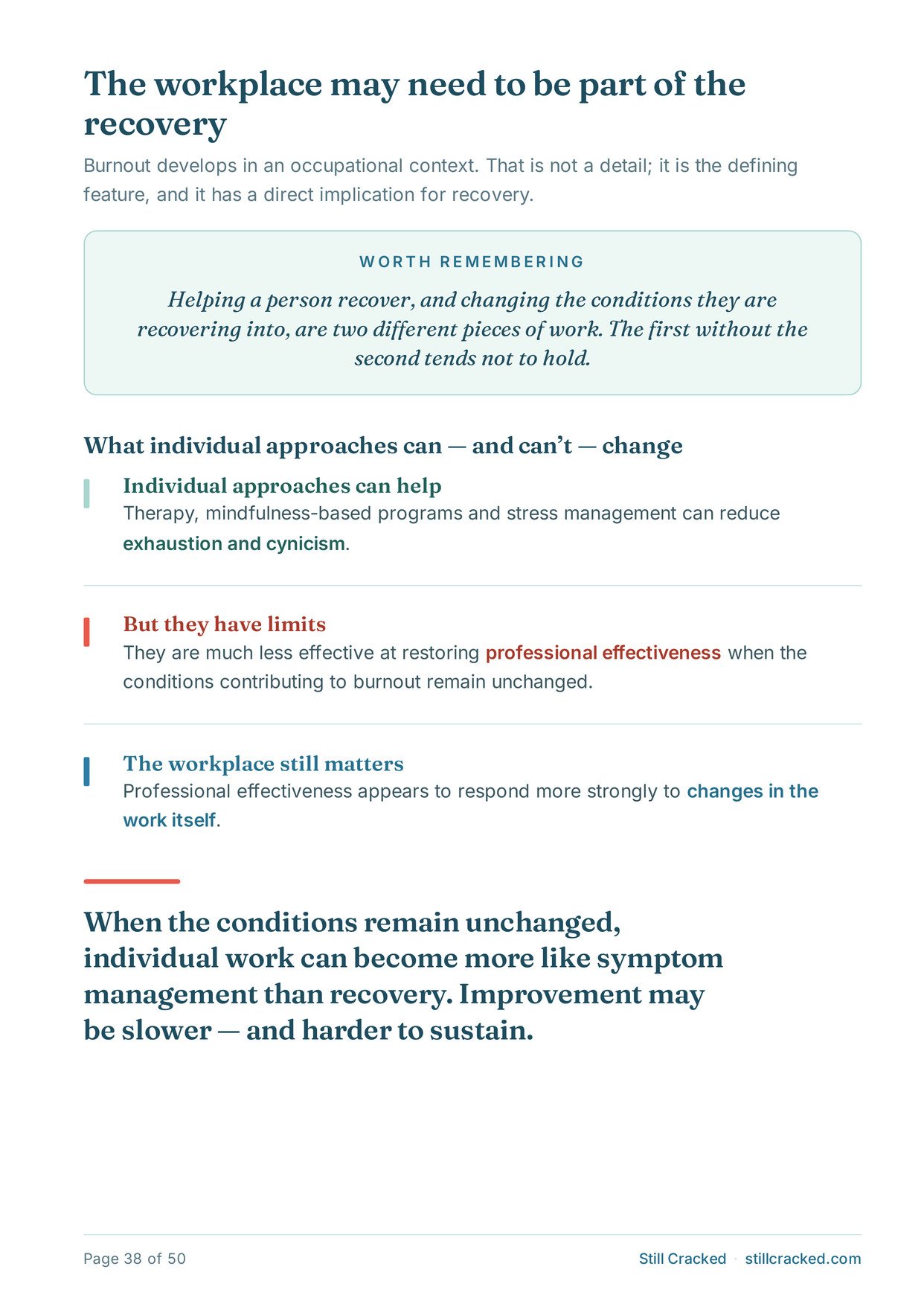
Individual approaches can help
Therapy, mindfulness-based programs and stress management can reduce exhaustion and cynicism.
But they have limits
They are much less effective at restoring professional effectiveness when the conditions contributing to burnout remain unchanged.
The workplace still matters
Professional effectiveness appears to respond more strongly to changes in the work itself.
Helping a person recover, and changing the conditions they are recovering into, are two different pieces of work. From the guide
The guide covers both — what a person can do, and what the conditions around them need to allow. It does not tell you that recovery is a matter of trying harder. It does not claim that changing the work guarantees recovery either. Where the conditions cannot change, the guide says so, and treats that as a real question rather than a failure of effort.
Who this guide is for
Written for adults who already know, or strongly suspect, that burnout is part of the picture.
- You have stopped work, or reduced your hours
- You are still at work, and the current pattern is not going to hold
- You feel somewhat better, but there is much less in reserve than there used to be
- Good days keep being followed by crashes
- You are trying to build back up without doing too much too soon
- You are preparing for a graduated return, or already partway through one
- You rested, and are trying to work out why that did not finish it
What you receive
Recovering from Burnout
- A 50-page PDF guide, designed to be read in pieces
- Evidence-informed explanations, with the references included
- The five-part recovery map, set out in detail
- Two fictional composite examples showing the map across a life
- Pacing and capacity tools, including a thirty-second daily check
- Return-to-work material that goes beyond hours
- Two worksheet pages to work through and come back to
- References and further reading
- Instant download — one payment, nothing recurring
An educational resource — not individual psychological, medical, legal, workers’ compensation or occupational-medical advice, and not a replacement for individual assessment or treatment.
Recovering from Burnout, next to the Burnout Reset Kit
Two different objects. Either one works on its own.
You are here
Recovering from Burnout — $22
Choose this if you want to understand recovery and find your way through it: what recovery involves, how capacity comes back, how to pace rebuilding, what changes psychologically, how the conditions at work bear on it, and how to approach going back.
50-page guide · read it through, or in pieces
Burnout Reset Kit — $27
Choose this if you want the much larger step-by-step workbook for actively working through the full burnout path: understanding what is happening, managing work while depleted, reducing load, rebuilding capacity and moving towards sustainable recovery.
Around 110 pages · a workbook to write in
What’s included
About the author
Suzanne Robertson
Psychologist · Founder, Still Cracked
Suzanne Robertson is an Australian psychologist with more than 25 years’ experience working with psychological health and wellbeing. Her work has increasingly focused on burnout, workplace psychological harm, moral injury and the ways working conditions can affect people’s mental health, functioning and capacity to recover.
Her research has examined burnout and recovery among Australian health professionals, including what recovery can look like over time. That research is cited in the guide.
Suzanne created Still Cracked to make psychologically informed ideas about work, burnout and recovery accessible outside the therapy room — in plain English, without reducing workplace problems to individual resilience.
Written by Suzanne Robertson — registered psychologist, twenty-five years of practice.
Still Cracked is education, not treatment.
Recovering from Burnout
Understanding what recovery looks like — and how to support it.
Not sure this is the one? Start with the free guide. It is the shortest route to working out which question is actually yours, and nothing here assumes you have read it.
Get the free guide