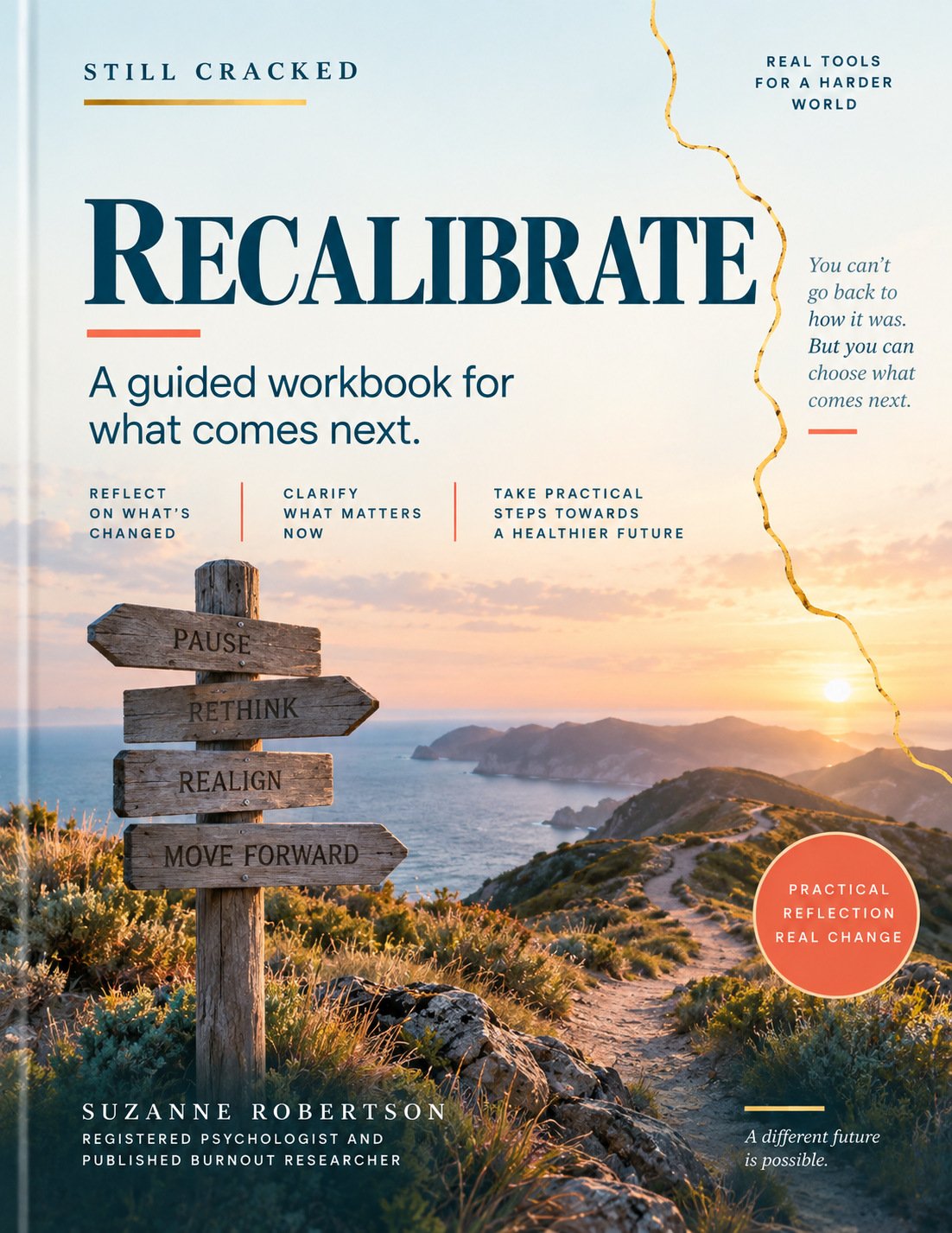
Or together
Overwhelm Reset System + RECALIBRATE
For getting through it now, and working out what has to change.
$46$39
Get both — $39Decide
RECALIBRATE
What has to change?
Things don’t have to be over. You just need enough room to think about what has to change — before you drift back towards the exact arrangement that produced this.
If you can’t think straight right now, start with the Overwhelm Reset System instead.
Four possibilities: stay, change, leave, not yet. You work through all four — including the ones you’re sure aren’t for you. The point isn’t to pick. It’s to find out what you already know.
Getting better isn’t much use if you go straight back to what depleted you. This is the slower question underneath recovery — what actually matters now, and what the next arrangement of your working life needs to protect.
What you get
Not values work in the abstract — decisions about the actual job, with the actual constraints, made while you can still remember what the bad version felt like.
Nine parts, with worksheets throughout. It moves in one direction — accurate description first, then what you want, then what you do about it — but nothing has to be done in order, and you can skip what doesn’t fit.
First, an accurate description
- Where you are now — what the work has taken and what it has given, side by side, because most people arrive convinced of one and blind to the other. Three pages that don’t ask you to decide anything yet.
- What matters to you now — finding your values, and then testing them across the areas of your life rather than in the abstract
- Where work sits in the rest of your life — the Life Map, and a worksheet for working out how much room it’s actually taking
Then, what you can and can’t accept
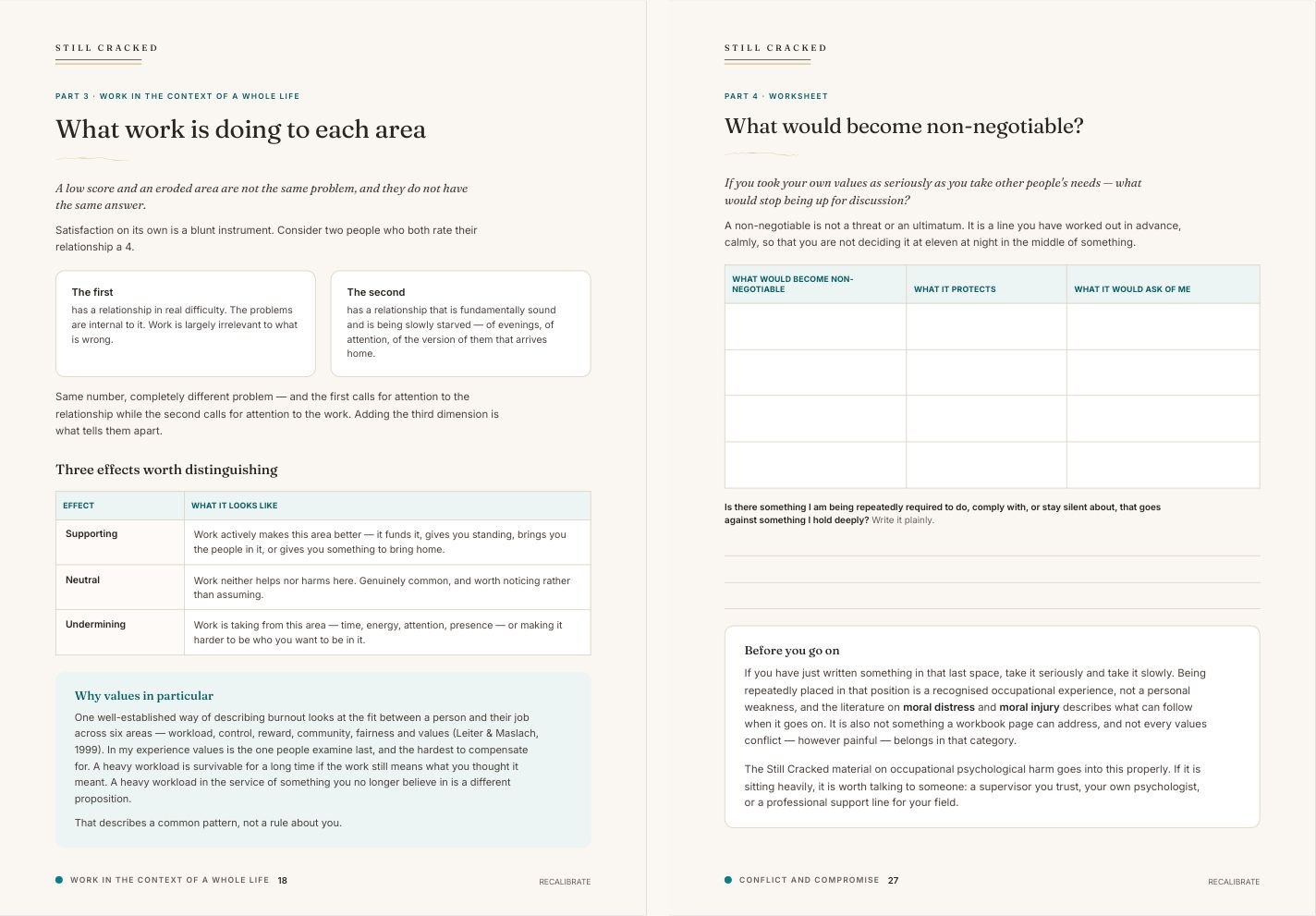
- Conflict, compromise, and what you can no longer accept — four situations that all get called “values conflict at work”, told apart because they need different responses: competing, chosen, imposed, and not acceptable
- What you actually want — deliberately short, easy to skip, and the part that stops you making the same change twice
Then, the four possibilities and what you do next
- Stay · Change · Leave · Not Yet — a page each, worked through in full including the ones you’re sure aren’t for you. Not yet is a position, not a failure to take one — done properly it has a date on it and a list attached.
- Choosing where to put your attention — sorted by what things ask of you, not by impact and effort. That’s how you’d choose between projects, not between parts of your life.
- Making it something you’ll actually do — five plain questions, and one test applied throughout: would you still do this on a Thursday when everything has gone wrong?
- Staying with it — the Weekly Reset, one page for when you stall, one for the weeks that go badly. No habit grid, no streak to protect, no reward system.
What changes is that “What do I do?” stops being one enormous question. You can see what would have to change for staying to work, what changing something might actually involve, whether leaving is something you’re moving towards rather than simply escaping from — and whether Not Yet is the most honest answer for now. You don’t have to finish with a major decision. Clarity can be enough.
A workbook, not a course — no videos, no modules, no login, nothing that expires.
On a day when opening a workbook is more than you have: there’s a ten-minute version at the front — three questions, then stop.
Next to the Overwhelm Reset System: that one is for when you can’t think straight right now. This one is for when you can think, but need to work out what has to change.
Next to the Burnout Reset Kit: the Kit is for getting some capacity back. This is for working out what has to change. You don’t have to finish one before the other — the workbook is for afterwards, or alongside.
Written by Suzanne Robertson — registered psychologist, Board-Approved Supervisor with the Psychology Board of Australia, twenty-five years of practice. Still Cracked is education, not treatment.
Change of mind isn’t covered on instant downloads. Your rights under the Australian Consumer Law are not affected: if something doesn’t arrive, won’t open, or isn’t what was described, email hello@stillcracked.com and it will be put right.
Take a look inside
Which one do you need?
Four questions, not a sequence. Start with whichever one matches what you need now.
Understand
What happened to me?
What Work Can Take
Respond
How do I get through today?
Overwhelm Reset System
Recover
Burnout is the problem. What do I need?
Burnout ProfileHow far has this gone, and what should I do first?Burnout Reset KitHow do I start getting some capacity back?Decide
What has to change?
RECALIBRATE
You are here
Still not sure which one is yours?
Then don’t spend anything yet. What Work Can Take is the shortest route to working out which of these four questions is actually yours — and nothing on this page assumes you’ve read it.
Read the free guide