What is moral injury at work?
Sometimes the hardest part of work isn’t how much you’re doing.
It’s what you’re being asked to do, accept or watch happen.
You may know what someone needs but lack the resources or authority to provide it. You may be required to carry out a decision you believe will cause harm. Or you may raise a serious concern and watch nothing change.
Sometimes what stays with you isn’t just exhaustion. It’s the feeling that something important was wrong.
What is moral injury?
Moral injury describes lasting effects that may follow experiences that seriously conflict with someone’s values or sense of what is right.
It can involve things you did, witnessed, were required to accept or felt unable to prevent.
People may experience guilt, anger, betrayal, grief or a loss of trust in themselves, their organisation or their profession.
Moral injury isn’t a mental-health diagnosis. There is no single agreed definition, and not every morally difficult experience leads to lasting harm.
It’s a way of understanding what may have happened, not a label that automatically explains everything.
What might moral injury look like at work?
Imagine assessing someone who needs admission, but there is no bed available.
You send them home with a safety plan you don’t believe is adequate.
You followed the process available to you, but you’re left with the knowledge that you couldn’t provide the care you believed was needed.
The difficulty isn’t simply that the shift was demanding. It’s that you were involved in a decision that conflicted with your professional judgement.
This is one example of a morally troubling situation. It doesn’t mean everyone who experiences something similar will develop moral injury.
How is moral injury different from burnout?
Burnout commonly involves exhaustion, growing distance from work and feeling less effective.
Moral injury involves a different kind of difficulty: a serious conflict between what you believe is right and what happened, what you were expected to do or what you couldn’t prevent.
You can experience both.
| Burnout may sound like | Moral injury may sound like |
|---|---|
| “I have nothing left to give.” | “I knew this wasn’t right.” |
| “I can’t keep working at this pace.” | “I was expected to go along with it.” |
| “I don’t feel effective anymore.” | “I couldn’t do what the situation required.” |
These aren’t diagnostic questions. They’re different ways people may describe their experiences.
Rest can help with exhaustion. Reducing workload can help restore capacity.
But neither necessarily resolves guilt, betrayal or the knowledge that people may have been harmed.
Sometimes the problem isn’t only what work demanded of you. It’s what work required you to do with what you had.
What’s the difference between moral distress and moral injury?
The terms are related, but they aren’t interchangeable.
Moral distress can occur when you believe you know the ethically appropriate thing to do but constraints prevent you from doing it.
You can see what should happen. You can’t make it happen.
Moral injury refers to more enduring effects that may follow some morally troubling experiences.
Not everyone who experiences moral distress develops moral injury. Researchers haven’t established a simple progression from one to the other.
Both concepts can help describe an experience without turning it into a diagnosis.
What might moral injury feel like?
There isn’t one fixed set of symptoms.
After a morally troubling workplace experience, some people describe:
- Guilt or self-blame: “I should have done more.”
- Anger or disgust: particularly about decisions or practices they considered unacceptable.
- Betrayal or lost trust: “I thought this organisation stood for something different.”
- Replaying events: going over what happened or what they wish had happened.
- Grief or disconnection: feeling that the work or professional identity they valued has changed.
These experiences can also occur with burnout, traumatic stress, depression and other forms of workplace harm.
The label matters less than understanding what happened and how it’s affecting you.
What kinds of workplace situations can contribute?
Moral conflict can arise in many jobs, not only healthcare.
For example:
- You can’t provide what someone needs. You know more help is needed, but the service or resources aren’t available.
- You must implement a decision you disagree with. You didn’t make the decision, but you’re responsible for carrying it out.
- A risk you warned about is ignored. You raise concerns, but nothing changes.
- Speaking up has consequences. Your concerns are dismissed or you’re treated as the problem.
These situations don’t automatically cause moral injury.
They do illustrate why some workplace distress cannot be understood simply as difficulty coping with a demanding job.
What can help after a morally troubling workplace experience?
There isn’t one established treatment specifically proven effective for moral injury. That doesn’t mean support or psychological care can’t help with the distress someone is experiencing.
A few general considerations may be useful.
Describe the problem accurately.
If the difficulty involved an ethical conflict, calling it stress may miss something important.
Look at where responsibility actually sat.
What authority did you have? What decisions were yours, and what belonged to the organisation?
This isn’t about avoiding legitimate responsibility. It’s about understanding it accurately.
Consider what you need now.
That might include rest, trusted support, professional care, advice about workplace options or time to make sense of what happened.
There isn’t one correct response for everyone.
What if the workplace itself needs to change?
Individual support can be valuable. It can help people understand their experiences and recover from distress.
But it cannot make unsafe staffing adequate, undo a harmful decision or guarantee that concerns will be taken seriously.
Where workplace systems repeatedly create situations that conflict with professional and ethical responsibilities, prevention also requires changes to those systems.
A wellbeing webinar cannot resolve an ethical conflict that the organisation continues to create.
And being unable to fix a problem you didn’t have the authority to fix isn’t automatically a personal failure.
What can I do next?
-
Feeling exhausted as well?
Read Burnout symptoms: signs you may be burning out at work.
-
Wondering whether the working conditions are part of the problem?
-
Was the process of raising concerns itself difficult or unfair?
-
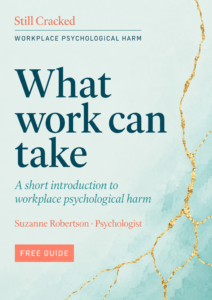
Trying to make sense of the wider impact of work?
Explore the free guide What Work Can Take.
If the experience continues to cause significant distress, affects your functioning or feels difficult to move beyond, consider speaking with your GP or an appropriately qualified health professional.
If you need urgent support, see Support and crisis services.
Evidence and further reading
Research on moral injury is still developing, particularly outside military settings. Definitions, measurement and treatment approaches remain under investigation.
The distinction between moral distress and moral injury is important, and neither should be treated as a diagnosis.
References
- Croak, B., et al. (2026). Moral injury in healthcare workers: causes & interventions. British Medical Bulletin, 157(1), ldag011. https://doi.org/10.1093/bmb/ldag011
- Dean, W., Talbot, S. G., & Dean, A. (2019). Reframing clinician distress: moral injury not burnout. Federal Practitioner, 36(9), 400–402. (Editorial.)
- Habib, T., et al. (2026). Moral distress and moral injury in healthcare: a review and instrument analysis. Journal of Health Psychology, 31(9), 3439–3453. https://doi.org/10.1177/13591053251398337
- Jameton, A. (1984). Nursing Practice: The Ethical Issues. Prentice-Hall.
- Litz, B. T. (2025). Moral injury: state of the science. Journal of Traumatic Stress, 38(2), 187–199. https://doi.org/10.1002/jts.23125
- Litz, B. T., et al. (2009). Moral injury and moral repair in war veterans: A preliminary model and intervention strategy. Clinical Psychology Review, 29(8), 695–706. https://doi.org/10.1016/j.cpr.2009.07.003
- Morley, G., et al. (2019). What is ‘moral distress’? A narrative synthesis of the literature. Nursing Ethics, 26(3), 646–662. https://doi.org/10.1177/0969733017724354
- Shay, J. (2014). Moral injury. Psychoanalytic Psychology, 31(2), 182–191. https://doi.org/10.1037/a0036090
- World Health Organization. (2019). Burn-out an “occupational phenomenon”: International Classification of Diseases.