How to regulate your nervous system when you’re overwhelmed
Sometimes you’re exhausted but can’t settle. Your thoughts are racing, your shoulders are tense, or you’re reacting more strongly to things that wouldn’t usually bother you.
Other times, you feel flat, disconnected or unable to get going.
And sometimes you manage both in the same afternoon.
Feeling overwhelmed doesn’t always look like feeling anxious.
What are the signs that you’re overwhelmed?
You might notice:
- feeling tense, restless or constantly on alert
- racing thoughts or difficulty concentrating
- becoming unusually irritable or sensitive to noise
- feeling emotionally numb, flat or disconnected
- struggling to make decisions or get started
- feeling exhausted but unable to relax
- needing much longer than usual to recover from ordinary demands.
These experiences can have different causes. They don’t automatically mean something is wrong with your nervous system.
The pattern matters, especially when these changes are persistent or affecting daily life.
What does nervous system regulation actually mean?
Your nervous system helps your body respond to changing demands.
When something feels threatening, urgent or overwhelming, your body can become more alert and ready to respond. You may notice faster breathing, muscle tension or difficulty settling.
At other times, stress can leave you feeling depleted, slowed down or disconnected.
Regulation is about being able to respond to demands and return towards a more settled state when those demands have passed.
It doesn’t mean staying calm all the time.
Healthy regulation isn’t constant calm. It’s being able to respond and recover.
Why can’t I just calm down?
Because your stress response isn’t controlled entirely by conscious choice.
You can know intellectually that the working day is finished and still feel tense, restless or preoccupied.
You may also be dealing with demands that haven’t actually ended: an unresolved conflict, tomorrow’s workload, uncertainty about your job or the expectation that you’re always available.
And when pressure continues for long periods, there may be little opportunity for recovery.
Knowing you’re safe and feeling settled aren’t always the same thing.
What can help when I’m overwhelmed?
Different approaches help different people. You don’t need to find the perfect technique or force yourself to relax.
A few possibilities:
Slow things down.
Try breathing gently and comfortably, perhaps allowing your exhale to be a little longer. Avoid forcing deep breaths if they make you uncomfortable or light-headed.
Use your surroundings.
Notice your feet on the floor, look around the room or focus on something you can see, hear or touch. This can help bring your attention back to the present.
Move if you need to.
Walking, stretching or changing position may feel more useful than sitting still, particularly when you’re restless.
Reduce what’s coming at you.
Noise, notifications, conversations and competing tasks can become harder to manage when you’re already overloaded. Reducing stimulation or taking a brief break may help.
Choose connection or space.
Sometimes talking with someone supportive helps. Sometimes you need quiet and time alone. Neither is automatically the better response.
You don’t have to do all five.
The useful question is: what helps me feel a little more able to manage what’s happening right now?
Can I reset my nervous system?
You’ll see plenty of advice online about resetting your nervous system, activating your vagus nerve or moving your body into a particular state.
Some suggested activities — such as gentle breathing, movement or relaxation — can help people feel more settled.
But the idea that one exercise can reliably reset your nervous system is an oversimplification.
Your nervous system is continuously responding to your body, your environment and your circumstances. It isn’t a device with a reset button.
There are also popular explanations based on Polyvagal Theory. Some aspects of that theory remain scientifically contested, so it shouldn’t be treated as a complete or settled explanation of how stress responses work.
You don’t need to believe a particular nervous system theory to use a strategy that genuinely helps you.
What if the problem is what keeps overwhelming me?
This is where individual regulation strategies have limits.
A breathing exercise might help you settle after a difficult meeting. It won’t make an unmanageable workload manageable.
A walk might help you decompress after work. It won’t resolve an unfair workplace process or stop repeated exposure to aggression.
These strategies can still be valuable. They may help you get through difficult moments and recover afterwards.
But they don’t remove the need to examine the demands you’re responding to.
Some workplace problems cannot be solved inside an individual nervous system.
If you repeatedly need strategies to recover from the same working conditions, it may be worth asking what needs to change about those conditions — not just how you respond to them.
What can I do next?
-
Finding that work follows you home?
-
Feeling increasingly exhausted or detached?
Explore Burnout symptoms: signs you may be burning out at work.
-
Wondering whether your workplace is contributing?
-
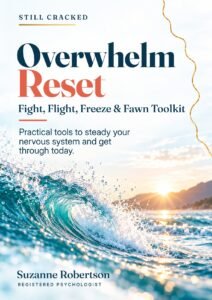
Want more practical support?
Explore Overwhelm Reset for a more structured approach to understanding and managing overwhelm.
If these experiences are persistent, significantly affecting your functioning or causing distress, speak with your GP or another appropriately qualified health professional.
If you need urgent support, see Support and crisis services.
Evidence and further reading
Stress responses involve interacting physiological, psychological and environmental processes. Regulation strategies may help with aspects of distress or arousal, but their effects vary between people and circumstances.
The scientific evidence supporting individual techniques differs, and some popular nervous system explanations make stronger claims than current research supports.
Relevant evidence areas include stress physiology, breathing and relaxation interventions, grounding techniques, Polyvagal Theory and workplace psychosocial hazards.
Further reading:
- McEwen (1998), New England Journal of Medicine — Protective and damaging effects of stress mediators
- Laborde, Allen, Borges et al. (2022), Neuroscience & Biobehavioral Reviews — Effects of voluntary slow breathing on heart rate and heart rate variability: a systematic review and a meta-analysis
- Muhammad Khir, Wan Mohd Yunus, Mahmud et al. (2024), Psychology Research and Behavior Management — Efficacy of progressive muscle relaxation in adults for stress, anxiety, and depression: a systematic review
- Amekran & El Hangouche (2024), Cureus — Effects of exercise training on heart rate variability in healthy adults: a systematic review and meta-analysis of randomized controlled trials
- Harrold, Keating, Larkin & Setti (2024), Applied Psychology: Health and Well-Being — The association between sensory processing and stress in the adult population: a systematic review
- Grossman, Ackland, Allen et al. (2026), Clinical Neuropsychiatry — Why the Polyvagal Theory is untenable: an international expert evaluation of the Polyvagal Theory
- Porges (2026), Clinical Neuropsychiatry — When a critique becomes untenable: a scholarly response to Grossman et al.’s evaluation of Polyvagal Theory
- Safe Work Australia — Psychosocial hazards
- Safe Work Australia — Model Code of Practice: Managing psychosocial hazards at work